
Everything You Need To Know About Porcelain Kitchen Floor Tiles
Porcelain kitchen floor tiles are dense, fired-clay tiles designed to take the kind of daily wear a busy kitchen actually delivers – spills, dropped pans, scuffs from chairs, claws from the dog, heat from the oven – the lot.
Mayfield Porcelain are a family-run tile retailer in East Sussex, supplying homeowners, builders, and kitchen designers across the country with a hand-picked range of porcelain tiles. Our role is to help you choose a floor that suits the way the room is laid out, the way the room is lit, and the way it gets used through the year, then back the choice up with practical advice on finish, format, and grout.
Porcelain is well-suited to kitchens for a few specific reasons. The fired body is non-porous, so it will not absorb grease, oils, or liquids the way some natural stones can. It conducts heat efficiently, which makes it one of the best floor surfaces to lay over underfloor heating. It does not warp around dishwashers and fridges the way wood can, and it is significantly more impact-resistant than ceramic. Add stone-effect, vintage, patterned, and large-format options across the range, and you have a floor that earns its keep without dictating the rest of the scheme.
Choosing A Kitchen Floor That Doesn’t Fail
Kitchen floors get more daily use than any other room in the house. Pans drop, chairs scrape, water pools by the sink, heat builds up by the oven, and grease drifts further from the hob than people realise. The two most common reasons a kitchen floor stops looking right are the wrong finish for the way the room is used and grout that was not properly sealed at handover. Both are avoidable. A textured or anti-slip face will hide wear far better than a polished surface. A correctly cured and sealed grout joint will stay even in colour for years rather than darkening unevenly.
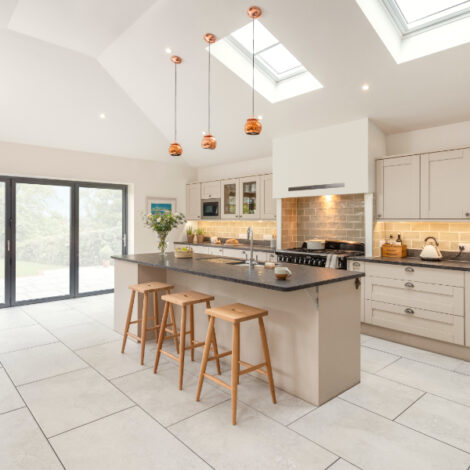
For a stone-inspired kitchen floor that handles all of the above, the Dunestone Tile is a useful reference. Soft white and ivory tones with subtle veining give it the character of natural limestone, but the porcelain body delivers far better stain resistance and consistency. It opens out to a kitchen that feels dark or hemmed in, sits well against modern units and doors, and pairs comfortably with brass or brushed-nickel ironmongery.
Care & Cleaning
A kitchen is the room you clean most often, so simple is better than excessive. Sweep or vacuum daily to lift crumbs and grit -these are the abrasive bits that scuff a finish if they are left to be walked on. Wash the floor weekly with warm water and a pH-neutral floor cleaner, and avoid the heavily perfumed all-purpose sprays that leave a sticky residue. Steam mops are fine on smooth porcelain but should be used sparingly on textured or anti-slip surfaces because the steam can push residue down into the texture over time. After installation, ask your tiler to lift any grout haze with the right product before the floor is sealed, and give the adhesive and grout the full curing time the manufacturer specifies before the kitchen goes into normal use.
Vintage & Patterned Options
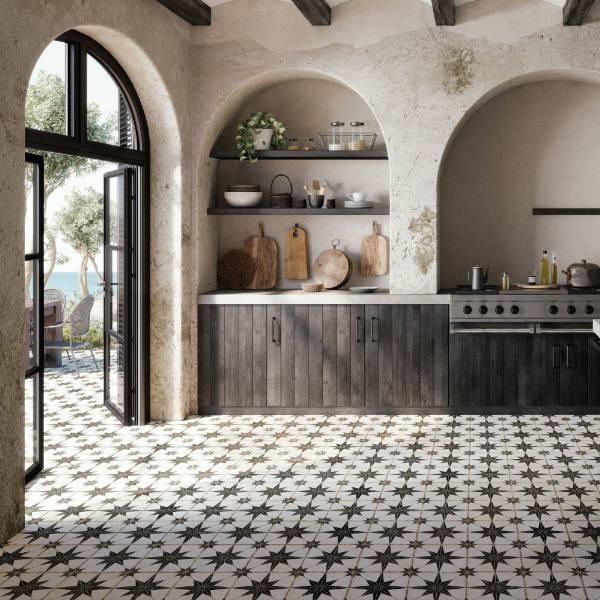
Kitchens benefit from a floor that has its own personality, especially in open-plan rooms where the floor is visible from other areas as well. Patterned and vintage porcelain tiles give a room character without committing the entire kitchen to a particular theme. Used on the full floor, they look traditional and confident. Used in a defined zone, like the area under an island or in front of a range, they can frame the working part of the kitchen and make the rest of the room feel calmer by contrast.
A clear example of how vintage tiles can lift a kitchen is the Cosmic Black Tile. Layer Tech production gives two finishes on the same face for a subtle, hand-crafted look, and the black accents work particularly well in kitchens with white or cream units, brass detailing, and warm timber tops. Because it is also rated for outdoor use, it can run from a kitchen out onto a covered terrace if your scheme calls for it.
Other Things To Consider
Format and grout choice are the two decisions that change how a kitchen floor reads more than any other. Large-format porcelain reduces the number of joints across the room, which makes the kitchen feel more spacious. Smaller formats and squares emphasise the joints, which works well in galley kitchens, in characterful properties, and in feature zones under an island. Grout shade does the rest of the work. A near-tile grout reads quiet and modern, almost as though the floor is one continuous surface. A slightly contrasting grout frames each tile and hides everyday marks more forgivingly. Whatever you choose, see a tile and grout sample together in the actual light of your kitchen before you commit; daylight in a north-facing room reads very differently from a showroom under spotlights.
Additionally, you should consider the price point. Porcelain tends to be the more expensive option, but other options typically need more maintenance, and some need replacing every 10 years. Weigh up the pros and cons, and come to a decision about the cost. We have a blog about what makes porcelain floor tiles more expensive, which is definitely worth reading if you’re not sure.
The Right Colour For The Room
Cool whites and greys suit kitchens that get plenty of natural light. Warmer creams, taupes, and soft browns suit kitchens that face north, kitchens with limited daylight, and rooms where the units are cool-toned. A floor that picks up a hint of the worktop or the kitchen island will tie the room together without competing with the units. If you are unsure between two tones, the safer choice in a working kitchen is almost always the slightly warmer of the two, because warm tones forgive crumbs and footmarks between cleans.
The Faye Garden Tile is a good example of a warm, characterful tile that earns its place in a kitchen scheme. Rooted in Mediterranean coastal design, the taupe palette and Layer Tech matte-and-gloss finish give the surface a hand-crafted feel that suits country kitchens, modern farmhouse looks, and city kitchens that want a softer floor underfoot. The colour sits comfortably next to oak, walnut, cane, and brushed brass.
Tiles That Suit Every Layout & Budget
Whether you are choosing porcelain kitchen floor tiles for a small galley, a sprawling open-plan kitchen-diner, a rebuilt cottage kitchen, or a new-build extension, the same principles apply. Pick the finish to match how the room gets used. Specify an R10 anti-slip rating where you can feasibly afford to, especially around sinks, dishwashers, and any door that leads outside. Choose the format to flatter the proportions of the room. Decide on grout shade in your own light, not in the showroom. And let the rest of the scheme follow, the units, the worktops, and the lighting all sit easier when the floor is right.
If you would like to see how a tile reads against your worktop sample or unit door, our showroom in Mayfield holds full ranges and complete schemes side by side. We will talk through the layout, the cooking habits in the house, and the way the kitchen catches the light through the day, and from there narrow down the porcelain kitchen floor tiles that fit the project.
Bestsellers


Are porcelain kitchen floor tiles suitable for underfloor heating?
Yes, and they are one of the best floor surfaces for it. Porcelain conducts heat efficiently and warms evenly, so the kitchen reaches a comfortable temperature quickly. Follow the heating manufacturer’s commissioning schedule and let the adhesive and grout cure fully before turning the system on.
Will porcelain kitchen floor tiles crack if I drop a heavy pan?
Quality porcelain is far more impact-resistant than ceramic, and well-laid tiles bonded to a sound substrate rarely crack from normal kitchen drops. A correctly prepared subfloor and the right adhesive matter as much as the tile itself, so use a tiler who works with porcelain regularly.
Do porcelain kitchen floor tiles stain?
The porcelain body itself does not stain, it is non-porous. Grout joints can pick up dirt over time, which is why we recommend sealing them once they have cured. Wipe up oil, wine, and acidic spills promptly, and the floor should look the same in ten years as it does on handover.
How slip-resistant should a kitchen floor be?
We recommend an R10 anti-slip rating at minimum for a busy kitchen, and R11 in wet zones or where the kitchen opens out to a garden or terrace. Polished porcelain looks beautiful in photographs, but is slippery when wet, which is a poor combination next to a sink or a dishwasher.
Can I lay porcelain kitchen floor tiles over an existing floor?
Sometimes yes. The existing floor needs to be sound, level, and free of movement, and the build-up needs to clear thresholds and appliance feet. Your tiler will check, prime the existing surface, and use the right adhesive. If the old floor is loose, cracked, or hollow-sounding, it is usually better to lift it.
Get In Touch
If you are weighing up porcelain kitchen floor tiles for a project, the simplest step is a short conversation about the kitchen itself. Pop into our showroom in Mayfield, East Sussex, or call us on 01435 512 301 and we will help you choose the floor that suits the way you cook, live, and entertain.
