
The Appeal
The reason why herringbone floor tiles work in everyday homes often comes down to what the pattern does underfoot. It adds direction, movement and structure to a floor without needing to shout about it. That’s not a small thing. It’s based on the fact that this layout works across a huge range of interiors, from compact hallways to open-plan kitchen floors, in houses old and new. The pattern has been used in floors for centuries, and it keeps coming back because it does something a standard straight-lay tile simply doesn’t.
Visual Rhythm
It’s also worth understanding why herringbone floor tiles work in everyday homes from a purely visual standpoint. A flat run of rectangular tiles, laid end to end, gives you a clean and practical floor. That’s perfectly fine. But herringbone floor tiles give you something extra. They create a visual rhythm that pulls the eye along the floor rather than stopping it. In a hallway, that can make the whole run feel longer. In a kitchen or living area, it adds a sense of detail that a plainer tile layout wouldn’t. None of this requires you to make a bold or risky decision. The herringbone pattern is structured and restrained by nature. It earns attention without demanding it.
A Lighter Tone
Not every home suits a dark or dramatic floor, and herringbone floor tiles come in a wide range of colours and finishes to reflect that. For homes that favour lighter, more neutral tones, the Essence Herringbone Porcelain Tile is a good example of how understated can still be interesting. It has a matt de-stone effect and draws on 76 different colour variations within the same colourway, which means the finished floor has depth and movement without being loud. At 4.6 × 18.4 cm and 8.5 mm thick, the format is well-proportioned for the herringbone layout. It’s suitable for bathrooms, hallways, kitchens, living rooms, bedrooms, and wet rooms, and it works with underfloor heating.
Compact Formats
One of the hesitations people have about patterned tiles is whether they’ll overwhelm a smaller floor. It’s a fair question, but herringbone floor tiles actually tend to handle compact areas well. Because the pattern creates movement rather than repeating a static block, smaller tiles in a herringbone layout can make a floor feel more considered and deliberate than a plain tile would. Bathrooms, cloakrooms, utility rooms and hallways are all natural candidates. The key is matching the tile size to the floor area. Smaller formats suit tighter settings, while longer tiles can work well where there’s more room to lay them out.
Visual Impact
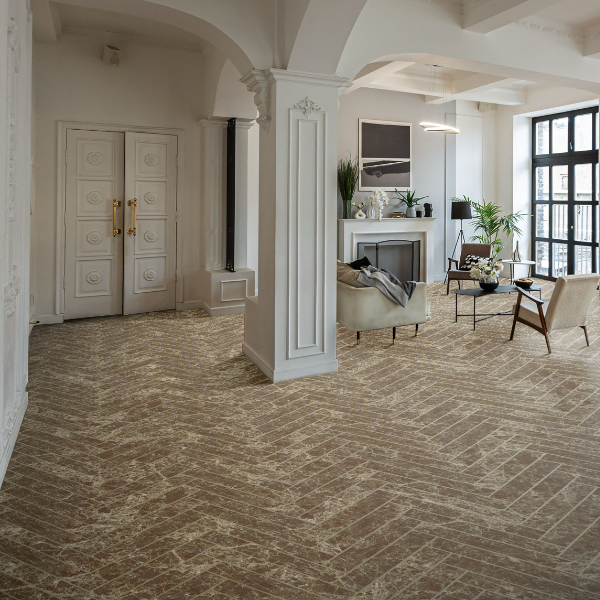
For homeowners who want a floor with real presence, herringbone floor tiles in a marble effect finish offer something genuinely different. This Gallery Porcelain Tile combines a deep chocolate-brown base with natural lighter veining and gentle tonal variation, arranged in the distinctive Zebra format that adds linear movement to the herringbone layout. It is available in four sizes, 7.5 × 15 cm, 7.5 × 30 cm, 10 × 30 cm and 10 × 60 cm, and works well for statement floors, hallways and feature walls. At 9.5 mm thick and manufactured in premium Italian porcelain, it is waterproof, underfloor-heating compatible and built to cope with everyday use.
Built To Last
Understanding why herringbone floor tiles work in everyday homes means looking at the practical side as much as the visual one. Porcelain tiles are dense and low-maintenance, resistant to moisture and straightforward to clean with warm water and a mild detergent. They are compatible with underfloor heating, which makes them a sensible choice for kitchens and bathrooms. The herringbone layout itself also means that any minor variation in the tiles, whether slight tonal shifts or natural markings, blends into the pattern rather than standing out as inconsistency. That’s one of the quiet advantages of this format, and it’s easy to overlook until you’ve lived with a patterned floor.
A Natural Warmth
For those who want the warmth and character of natural stone, the Bedrock Argento Herringbone Limestone is worth a close look. It’s a warm beige limestone with a natural tumbled surface, supplied on a mesh backing in sheets of 16 individual pieces, each measuring 200 × 30 × 20 mm. Because each piece is finished individually, the grout lines are not perfectly uniform. That variation is intentional and gives the floor a handmade, antique quality that suits older properties, country kitchens and period hallways particularly well. It is suitable for both internal and external use, including wet areas such as bathrooms and saunas, and it is compatible with underfloor heating.
Getting It Right
Grout colour has more influence over the finished look of herringbone floor tiles than most people expect. A closely matched grout creates a seamless effect where the pattern flows as a whole, while a contrasting grout picks out each tile and makes the geometry more defined. Neither is wrong. It depends on how much you want the layout to be the feature. It’s worth ordering a sample and testing both before committing.
It’s easy to see why herringbone floor tiles work in everyday homes when you look at how many settings suit them. Hallways are the most common application, as the pattern draws you through naturally. Kitchens, open-plan living areas and bathrooms all work well too. Where herringbone suits less is a floor mostly hidden under furniture, where very little of the layout is visible. In those cases, a simpler tile might serve you better.
Why Herringbone Floor Tiles Work In Everyday Homes
The answer to why herringbone floor tiles work in everyday homes is simpler than you might think. They look considered without being complicated, combining genuine visual interest with real practical durability. The pattern is ancient, but it keeps earning its place in modern homes because it does more than a flat tile layout without asking you to take a leap of faith. Whether you’re drawn to a lighter stone-effect porcelain, a rich marble-effect finish, or a natural limestone with handmade character, you end up with a floor that feels considered without being complicated.
If you’re local to East Sussex, you’re welcome to come and see our herringbone ranges in person at the Mayfield Porcelain showroom. Seeing the tiles in natural light and alongside other materials makes a real difference when you’re trying to make a decision. Not local? Call us on 01435 512301 or get in touch via our contact form and we’ll be happy to talk through your project.
Frequently Asked Questions
Are herringbone floor tiles hard to install?
Herringbone tiles require more planning and time than a straight-lay format because each tile needs to be set at a 45-degree angle to the two it joins. A competent tiler will be familiar with the layout, but it is not a job for a beginner. Allowing extra tiles for cuts is important before placing your order.
What size herringbone tile works best for a kitchen floor?
It depends on the size of the kitchen. Narrower, longer formats such as 10 × 30 cm or 10 × 60 cm tend to suit larger kitchen floors well, as they give the pattern room to breathe. Smaller formats, such as 7.5 × 15 cm, work well in tighter areas or where a more intricate look is desired. If you’re unsure, ordering samples and laying them out on the floor before committing is always a good idea.
Do herringbone floor tiles make a hallway look longer?
They can. When the herringbone is laid diagonally along the length of a hallway, the pattern naturally draws the eye forward, which can create an impression of greater length. Laying the same tiles straight across the width would have the opposite effect. The direction of the layout matters, so it’s worth discussing this with your tiler before work begins.
Can herringbone floor tiles be used with underfloor heating?
Yes, and this is part of why herringbone floor tiles work in everyday homes so well as a long-term choice. Porcelain tiles are well-suited to underfloor heating because of their density and thermal conductivity. Natural stone tiles also work, though it is worth checking the specific product specifications. All tiles mentioned in this blog are confirmed as underfloor heating compatible.
How do I clean herringbone floor tiles?
Porcelain herringbone tiles can be cleaned with warm water and a mild detergent. Avoid harsh chemicals or abrasive cleaning tools. Natural stone tiles such as limestone may require a stone-specific cleaner and periodic sealing, depending on the finish and the conditions they’re exposed to. Your supplier should be able to advise on the care requirements for the specific tile you choose.
How much extra tile should I order for a herringbone layout?
A wastage allowance of 10 to 15% is generally recommended for herringbone layouts due to the number of cuts involved at the edges. If the room has a complex shape or a lot of angles, allow for the higher end of that range. It’s always better to order a little more upfront than to need to reorder later, particularly as tile batches can vary in tone.
